I have tried to de-
To de-de-de de colonize
My own people
How do I explain this to my mother?
To my pastor?
That Christianity demonized our culture
While advocates for decolonization
Are commodifying and exoticizing our culture!
To de-de-de
De-colonizing
Deco-loni-ze
I see these politicians
Garbed in sacred weaving patterns
Claiming Indigeneity, mimic men
Refashioned in the image of the colonizers
Whereas the people are garbed
with high-end fashion clothes
Thrifted from crowded, dirty bazaars.
To de-colon-ize
Is to rid our minds
To unlearn about borders
Be they real or metaphorical
Borders, banks, barbed wires
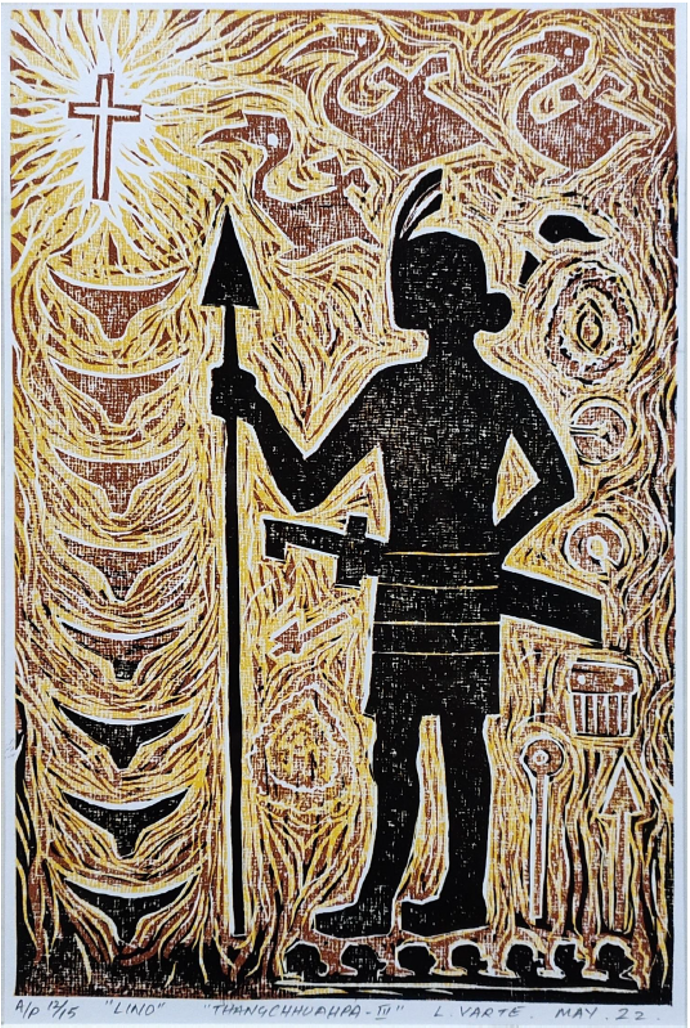
The cross or the hen
The priest or the bawlpu
To be stuck in binary thinking
Is to be re-co-lo-ni-ze-d
Give land back
Our forests back
our culture, our language back we are
still segregated by borders
but even if we got it back
Would my people cut down a forest
To build another new luxurious church!
The poem starts with the poet’s attempt at decolonization. It emphasizes ”decolonization” in every verse, intentionally fragmenting the word with apostrophes in different ways. This seems to be a deliberate play with the prefix ‘de’ signifying its difference and singularity from the prefix ‘post’. In speech, the prefix ‘de’ can also seem to suggest the Mizo romantic word ‘di’. Starting with their people, mother and pastor, the poet attempts to explain how, with the advent of Christianity’s victory over his people, that Christianity demonized their culture. The poet also adds how advocacy for decolonization are commodifying and exoticizing their culture. The poem talks about how decolonization can be something regressive as well, how it can be used by chauvinism and the market to exploit it for its own gain.
Mentioning politicians wearing “sacred weaving patterns” while claiming indigenous- here the poem uses a jarring term “mimic men”- accuse his people of losing their identity and becoming people who mimic others. “Refashioned in the image of the colonizers”, the poem brings to understanding what he accuses the mimic men of copying. In its context, the poem explains how indigeneity became an after-image of colonizers. Without waiting for the reader to catch their breaths, the poem adds how people are clothed in high-end fashion, juxtaposing the ‘politicians’ wearing woven textiles.
In the third stanza, the poem explains how decolonization is to take place genuinely, “to rid our minds” would be to unlearn, to unlearn borders, real and imaginary. Adding banks to the mix, the poem throws in a critique of capital and wealth, but goes on to barbed wire, a violent representation of borders. The cross or the hen, tools of rituals, the priest or the bawlpu, the keepers and practitioners of knowledge and religion. Ending the verse with “To be stuck in binary thinking is to be re-co-lo-ni-ze-d”, a sharp jab at binary thinking, accusing it of recolonization.
The ending verses talk about land rights and taking back of land, culture and language, lamenting how people are still segregated by borders. The ending climaxes all the points mentioned so far and asks if when people get their land back, would they cut down forests, to build another luxurious church.